
Answers about wood and our service
Here are the most common questions about our products, wood species and ordering. Click a topic to open it.
Downloads
You will find our terms of delivery, installation instructions, certificates, grading rules and complaint forms on the Downloads page.
How do I collect the products I ordered?
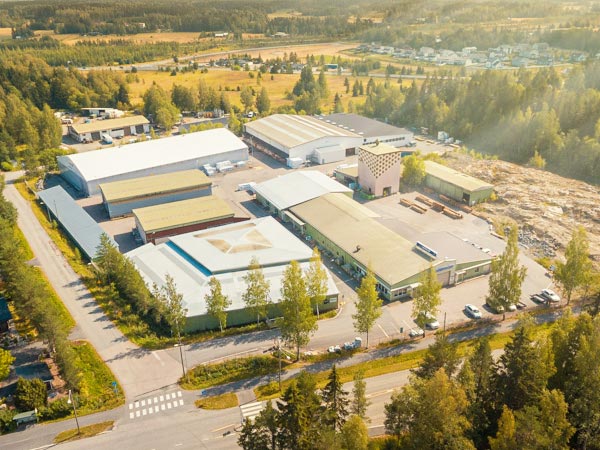
We work mainly through retailers. Our site in Lempäälä is a collection point for completed orders during our published opening hours. You can place a collection order through a retailer, and we will pick all products in the order for the agreed day. When you order directly from us, you can pay by card on collection by prior arrangement, or we invoice your order in advance. We do not handle cash. If you ordered through a retailer, agree on the payment method with the retailer.
Does Lauta Oy offer a cutting service?
Lauta Oy does not offer a cutting service. Products are sorted by length, so the pieces in a pack are very close to the length stated on the pack. The stated length is not the installed length. Individual pieces inside a pack may sit slightly offset, so the total length of the pack can exceed the length of the pieces. Keep this in mind when you choose how to transport the goods.
Properties of timber
Wood is a natural material: its appearance and properties vary with the species, treatment, dimensions and the part of the tree the piece comes from. Always choose the species and treatment to suit the application. Colour, grain and knots shape the final look. Density, resin content, knots, piece size and treatment affect the properties.
We grade our timber to our own quality standards based on the Finnish RT building information cards. Spruce and pine are sorted into several grades.
Wood moves with moisture, and you need to allow for this in every installation. Let wood for indoor use acclimatise for about 2 weeks in the room where it will be installed. Outdoors, allow for moisture movement in the fixings and in the gaps between deck boards.
All wood species move with humidity, check as they dry and change colour over time. You can influence these properties, for example by treating the surface. Thermally modified wood fades and untreated wood darkens over time. Moisture movement varies by species, and thermally modified wood moves less than the same species without thermal modification.
Wood species and applications
Indoors
In heated interiors, the main thing to consider is how humidity changes with the seasons. Let the wood acclimatise indoors for about 2 weeks; this reduces movement after installation.
Indoors, protect the wood from dirt with oil, wax, lacquer or paint. When you choose a species, consider its properties and the result you want.
Sauna
Gentle steam, calm and a beautiful space. The sauna is a place to relax, catch up and unwind – a space where a wooden surface is both soothing and practical. Thanks to its low thermal conductivity, a wooden bench stays pleasant to the touch even in hot steam.
The traditional species for sauna surfaces are spruce, aspen and alder. Aspen and alder are also available thermally modified. Newer favourites for saunas include thermally modified radiata pine and western red cedar. For all of these, the best treatment is paraffin oil, which does not hide the colour or grain of the wood.
Conditions in a sauna are exceptional because of the extreme heat and humidity. When you choose a species, consider its resin content and density. The surface treatment and colour you want also affect the options. Dense wood conducts heat better than less dense wood, so its surface feels hotter to the touch.
The denser the wood, the hotter a bench surface feels. For benches in particular, choose a species that feels comfortable even when it is hot. Resinous wood, such as pine, releases sticky, hot resin as the sauna heats up. Thermal modification changes the properties of wood: among other things it removes resin and reduces moisture movement, which makes thermally modified pine an option for saunas too.
You can leave the sauna with a traditional bare wood surface, in which case we recommend paraffin oil. Paraffin oil protects the wood from checking and makes cleaning easier. Oiled wood absorbs water less readily than unoiled wood, so a bench, for example, does not swell as easily.
Outdoors
Outdoors, wood is exposed to the weather. Changes in temperature and humidity and UV light wear the wood. A surface treatment protects it from the weather.
See also the wood species suitability table.
What do the letter codes in product names mean?
The letter codes in a product name describe either the profile of the product or its grade. The codes come from the Finnish words.
Profile codes
Panels
| Use | Tongue and groove | Joint profile |
|---|---|---|
| S Interior (sisä) | T Full (täysi) | S Straight (suora) |
| U Exterior (ulko) | Y Simple (yksinkertainen) | V Bevelled (viisto) |
| W Angled bevel (vinoviisto) | ||
| K Decorative (koriste) | ||
| P Rounded (pyöristetty) | ||
| H Log (hirsi) |
The joint is 10 mm unless a different width is given as a number.
For example:
| STS4 | S interior cladding board, T full tongue and groove, S straight-edged joint, joint width 4 mm |
| UYS | U exterior cladding board, Y simple tongue and groove, S straight-edged joint |
Planed boards
| SHP | rounded edges |
| SH | straight edges |
| KHP | rough-planed textured surface, board with rounded edges |
Grade codes
| Knots | Species |
|---|---|
| E Special grade (erikoisluokka) | M Pine (mänty) |
| V Few knots (vähäoksainen) | K Spruce (kuusi) |
| T Sound knots (terveoksainen) | |
| O Knotty (oksainen) |
See all grades on the Quality classification page.
Panelling
Panelling is an easy and beautiful way to bring wood into your interior. Use panels for a feature wall or a ceiling, for example. Each species has its own grain and colour, and with surface treatment you can achieve anything from light to dark tones. The profile, width and direction of the panel also affect the final look.
Humidity changes with the seasons and differs from house to flat, room to room and storage to storage. Wood is hygroscopic, so it adapts to the humidity around it. An important step in installing panels is to let them acclimatise: bring them into the room where they will be used about 2 weeks before installation. This keeps moisture movement after installation to a minimum.
Installation
For the best result, space the battens no more than 600 mm apart. Fit the battens at right angles to the panels: for horizontal panelling, the battens run vertically. Plan any joints and extensions in advance.
When you panel several walls horizontally, do all the walls at the same time. This makes it easier to keep the panels level at the corners on every wall.
Second grade (II)
A second-grade (II) product is made in the same batch as the equivalent first-grade (I) product but, for one reason or another, does not meet the first-grade requirements. These products work in the same applications as first-grade products. If you want a first-grade look, allow for more waste in the quantity. A surface treatment can also hide some defects.
Second-grade products are sold as clearance lots. We usually sell them in full forklift bundles (e.g. 300 m), so check the available lot sizes with our sales team. We do not deliver these products unless you accept the quality in advance, and there is no right of return. We recommend that you come and approve the quality on site. The products cannot be exchanged or returned.
Fixing
Always choose fixings to suit the material and the application. Screws and nails must be long and strong enough. Pre-drilling is always recommended when you use screws, to prevent splitting. Durable fixing is just as important to the result as the material you fix.
Decking
For Douglas fir decking we recommend screws of 4.2x55 mm (board thickness 18–21 mm), 6x70 mm (28 mm) and 6x120 mm (45 mm), with joists spaced 400–800 mm apart depending on the thickness. The recommended screw is stronger than a typical decking screw because of the properties of Douglas fir. As a dense wood (over 600 kg/m³), Douglas fir moves considerably with the seasons, and screws that are too weak can snap.
Leave a large enough gap between Douglas fir boards, because the wood absorbs moisture, especially in autumn and spring. Autumn rain and meltwater in spring cause problems for decks installed with gaps that are too narrow.
Sauna benches
Always screw sauna benches to the battens and frame. Fix the bench boards to the frame by screwing from below. Screws of the right length do not show through on the visible side but hold the boards firmly to the frame.
In all spaces where the surface is in contact with water or moisture, we recommend stainless steel screws. Always use stainless steel screws with thermally modified wood.
Panels
Always fix panels to battens. You can nail panels through the face or through the tongue. The wider the panel, the more it moves. Face nailing holds the panel best. Take care not to dent the panel during installation.
In all spaces where the surface is in contact with water or moisture, we recommend stainless steel screws. Always use stainless steel screws with thermally modified wood.
Mouldings
Moulding nails and moulding plugs are available for fixing mouldings. When you choose moulding nails, the most important thing is the right length. Moulding plugs are mainly used on concrete walls and come in different sizes and colours. After fixing with nails or plugs, you can fill and paint over the fixing points.
Sales units: pieces, packs and forklift bundles
We always sell products as whole pieces in packs. A whole piece means the full length. The pack size is shown in the product details, 1–6 pieces per pack depending on the product. Occasionally the last pack of a batch may be smaller than usual.
Painting
A surface treatment can bring out the natural beauty of wood and give it a finished look. Options include stains, paints, lacquers and oils, which can change the colour, texture and sheen of the wood.
A surface treatment helps protect wood from its environment, such as moisture, sunlight and changes in temperature. With the right treatment, the same product works in many different applications. The right treatment is especially important for the durability of wooden surfaces in saunas and outdoors.
Treated wood needs less maintenance than untreated wood. A treatment can help repel dust and dirt, which makes cleaning easier.
All in all, surface treatment is an important step in protecting and preserving wood and enhancing its beauty. With the right treatment, wood products last longer, look better and need less maintenance.
Paint shop
We carry out painting and surface treatment in our own industrial paint shop. We can offer a wide range of custom colours and finishes to match your needs and preferences.
Our paint shop can complete large painting projects quickly and efficiently. With modern equipment and automated processes, we deliver surface-treated products on time.
Paints and batch size
For all surface treatments we use water-based, environmentally friendly paints and finishes from Teknos Oy. The paint shop treats batches of at least 500 m per finish. If the line settings do not need to change, different products can be treated in the same batch to make up the 500 m minimum.
Downloads

Contact

Wood species
Didn't find what you were looking for?
Our customer service is here to help on weekdays from 8 am to 4 pm Finnish time, tel. +358 3 3123 6000.